Amino Acids in Honey: A Small Fraction With a Big Role in Flavor
Amino acids in honey make up a tiny share of each jar, yet they influence the color, aroma and character you notice when you open the lid. They also help scientists judge whether a honey is genuine and where it may have come from. This article explains which amino acids in honey are found, how they get there, how they react with sugars to create flavor, and why honey is still not a protein food. For the most important one, read proline in honey.
For general education only, not medical advice. Our honey is a food and is not intended to diagnose, treat, cure or prevent any disease.
How much protein honey contains
Honey is mostly sugar and water. Stefan Bogdanov's review of honey as a food puts protein at about 0.5 grams per 100 grams, made up mainly of enzymes and free amino acids. USDA FoodData Central lists about 0.3 grams per 100 grams for a generic honey.
In a single tablespoon that comes to well under a tenth of a gram. So amino acids in honey are not meaningful for nutrition. Their importance lies elsewhere.
Which amino acids in honey are found
Researchers have detected around 18 to 20 free amino acids in honey. Proline is usually dominant. The rest appear in smaller and highly variable amounts.
- Proline: usually the largest share, mostly from bees
- Phenylalanine: often elevated in some floral honeys
- Glutamic acid and aspartic acid
- Lysine, alanine, serine and glycine
- Tyrosine, leucine, valine and others in traces
Where amino acids in honey come from
Three sources contribute. Bees add proline and other compounds in their secretions while they ripen nectar. Pollen grains carry their own amino acids into the honey. Nectar itself contains small amounts that vary by plant.
Because pollen and nectar differ so much between flowers, the amino acid profile can act like a fingerprint. Some studies have used amino acids in honey to help classify floral origin.
Amino acids in honey and flavor
When amino acids meet sugars, they slowly take part in the Maillard reaction, the same family of reactions that browns toast and roasts coffee. In honey this happens very gradually at room temperature and much faster with heat.
Over months and years, the Maillard reaction darkens honey and deepens its aroma. That is why an older jar can look richer than a fresh one from the same harvest.
In baking, the reaction is a gift. Honey's sugars and amino acids help cakes and breads brown beautifully, which is why recipes with honey often call for a slightly lower oven temperature.
Amino acids in honey and quality testing
Labs use amino acids in honey, especially proline, to judge ripeness and spot dilution with syrups, which contain almost none. A review of honey biochemistry in Molecules describes how honey's components interact during ripening and storage, including reactions that involve amino acids and sugars.
These reactions also produce HMF, a compound that rises with heat and age. Our article on heating honey explains why HMF is a common quality check.
| Process | Role of amino acids |
|---|---|
| Ripening | Bees add proline and other compounds |
| Storage | Slow Maillard reaction darkens honey |
| Heating | Faster browning and more HMF |
| Testing | Low proline can signal dilution |
Should you eat honey for amino acids?
No. For protein and essential amino acids, eggs, dairy, legumes, fish, meat, nuts and whole grains are the right foods. Honey's job is flavor.
A nice pairing is honey with protein-rich foods. Try it on Greek yogurt, cottage cheese or a peanut butter sandwich. Our article on honey and cottage cheese has easy ideas.
Amino acids in honey and authenticity research
Scientists continue to explore amino acids in honey as part of authenticity testing. Some studies have found that certain amino acids, such as phenylalanine or tyrosine, are typical of particular floral honeys, which can support origin checks.
Others use the full amino acid pattern, together with sugars, minerals and pollen, in statistical models that sort honeys by type. The broader review of honey's contribution to nutrition and health lists amino acids among honey's minor but characteristic components.
Amino acids in honey at a glance
Here is the short version:
- Honey has only about 0.3 to 0.5 grams of protein per 100 grams.
- Proline is usually the most abundant amino acid.
- Bees, pollen and nectar all contribute.
- Amino acids react with sugars to darken honey over time.
- They are quality and origin markers, not a nutrition source.
Raw honey with full character
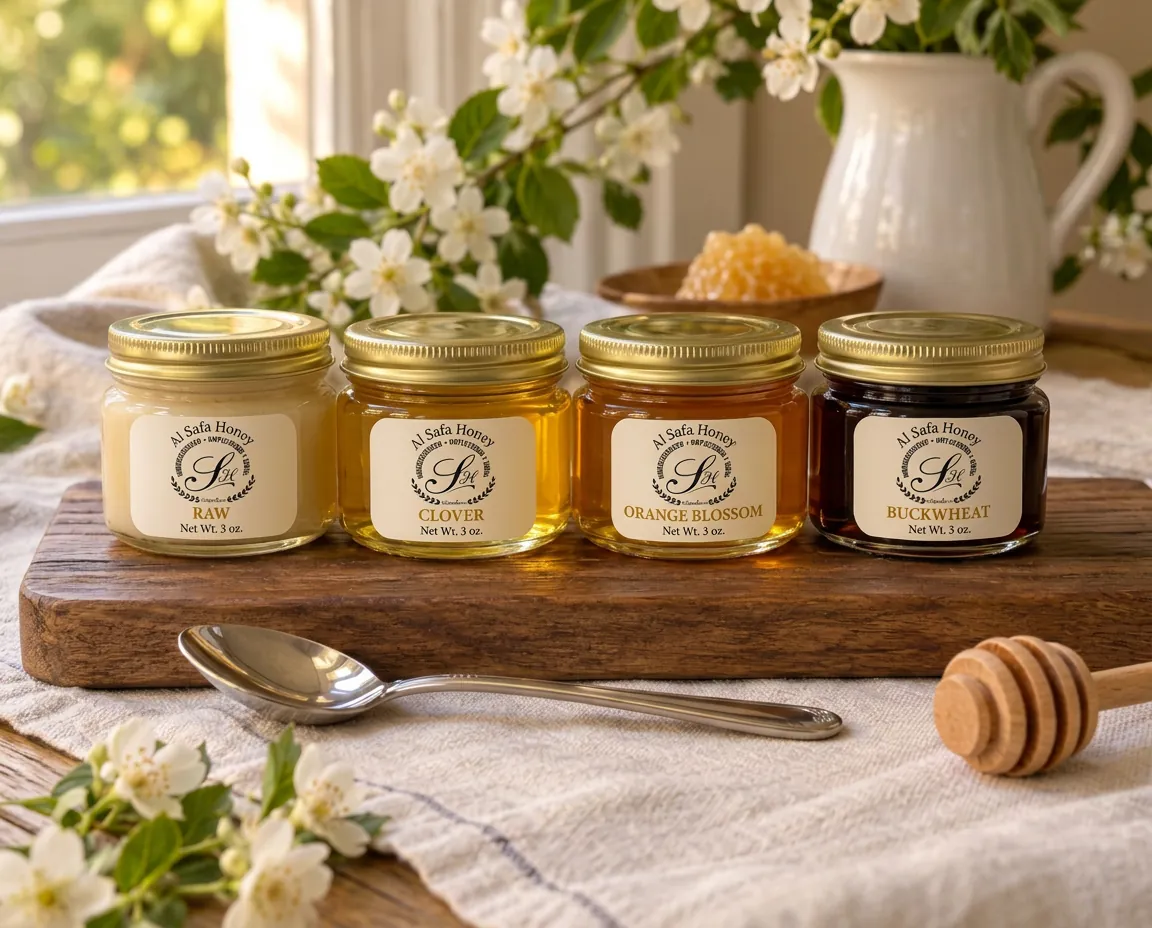
Amino acids in honey are part of what makes each floral source taste distinct. Raw honey, strained of wax only and never heated above hive temperature, keeps that natural character.
Taste the range with our Pure Raw Honey Sampler, or choose a favorite from our shop. Orders over $50 ship free.
Sources
Outside health sources we used for this article. They open in a new tab.
- Honey as Nutrient and Functional Food · Bee Product Science (Stefan Bogdanov)
- Biochemical Reactions and Their Biological Contributions in Honey · Molecules (via National Library of Medicine)
- Honey: nutrient profile · USDA FoodData Central
Frequently asked questions
- Does honey contain protein?
- Only a little, about 0.3 to 0.5 grams per 100 grams, mostly enzymes and free amino acids.
- Which amino acid is most common in honey?
- Proline. It usually makes up the largest share of the free amino acids in honey.
- Why does honey darken over time?
- Slow reactions between sugars and amino acids, called Maillard reactions, darken honey and deepen its aroma, especially in warm storage.
- Are amino acids in honey essential amino acids?
- Some are, such as lysine and phenylalanine, but the amounts are too small to matter for nutrition.
- Do amino acids in honey cause allergies?
- Honey allergies are uncommon and are usually linked to pollen or bee proteins rather than free amino acids. Anyone with a known allergy should check with a doctor.
- Does raw honey have more amino acids?
- Raw honey keeps more pollen, which carries some amino acids. The overall amount is still small.
- Can amino acids in honey identify its floral source?
- They can help. Some studies link certain amino acids to particular floral honeys, but experts combine them with pollen and other tests for reliable results.
Al Safa Honey is a food producer, not a medical provider. Nothing here is medical advice, and these statements have not been evaluated by the Food and Drug Administration. Talk to your doctor about any health concern. Never give honey of any kind to a baby under 12 months old.