Proline in Honey: The Amino Acid That Signals Ripe Honey
Proline in honey is a small detail with a big job in quality testing. It is the most plentiful amino acid in honey, and most of it comes from the bees rather than the flowers. Because of that, labs use proline as a clue about whether honey was properly ripened by the colony and whether it has been mixed with something else. This article explains what proline in honey is, why it matters to testers, and what it does and does not tell you as a shopper.
For general education only, not medical advice. Our honey is a food and is not intended to diagnose, treat, cure or prevent any disease.
What proline in honey is
Amino acids are the building blocks of proteins. Honey contains a small amount of protein and free amino acids, roughly half a gram per 100 grams according to Stefan Bogdanov's review of honey as a food.
Of all the free amino acids in honey, proline is usually the most abundant by a wide margin. In many honeys it makes up more than half of the total.
That makes proline in honey a convenient single number for labs to measure when they want a snapshot of honey's amino acid content.
Where proline comes from
Nectar and pollen contain some proline, but the larger share in finished honey is believed to come from the bees. Worker bees add secretions while they process nectar, and those secretions carry proline.
Because the bees add it during ripening, honey that was harvested too early, before bees finished their work, may show lower levels. Honey that has been diluted with sugar syrup will also show less proline, since syrups contain little or none.
Why labs test proline in honey
Honey testing labs check a set of markers rather than relying on any single test. Proline in honey is one of them. Some quality guidelines use a minimum of about 180 milligrams per kilogram as a sign of genuine, ripe honey, although results vary naturally by floral source.
A low result is not proof of fraud on its own. Testers combine proline with moisture, sugars, enzymes, pollen and isotope tests before drawing conclusions.
| Marker | What it can suggest |
|---|---|
| Proline | Ripeness and possible dilution |
| Moisture | Ripeness and fermentation risk |
| Diastase | Heat damage or age |
| HMF | Heating or long, warm storage |
| Pollen | Floral and geographic origin |
Proline in honey and honey fraud
Honey is one of the foods most often targeted by economically motivated adulteration, which means cutting it with cheaper syrups. The FDA has run sampling programs on imported honey to look for this.
Proline in honey is one of the older tools used to spot problems. Newer methods, such as isotope ratio testing and advanced spectroscopy, are now used alongside it because some syrups are designed to fool simpler tests.
For shoppers, the most practical protection is buying from producers who can tell you where their honey came from. Our guide on how to tell if honey is real explains what home tests can and cannot show.
Does proline in honey matter nutritionally?
Not really. A tablespoon of honey contains only a trace of protein, and proline is a nonessential amino acid that the body can make for itself. You get far more from eggs, beans, dairy, fish or meat.
The value of proline in honey is as a quality signal. It tells testers that the bees did their full job, which is also what gives honey its full flavor.
How variety affects proline levels
Different floral sources show different typical ranges. Some dark honeys tend to test higher, while some light honeys test lower even when they are perfectly genuine. Climate, colony strength and the timing of harvest all play a part.
- Floral source shapes the baseline level.
- Harvesting before honey is capped can lower it.
- Long storage can reduce it slowly over time.
- Mixing with syrup lowers it sharply.
Proline in honey around the world
Studies from many countries measure proline in honey as part of routine quality surveys. Results show wide natural variation. Honeys from some floral sources, such as chestnut or heather, often test high, while some citrus and acacia honeys test lower.
That variation is one reason experts treat proline in honey as a guide rather than a strict pass or fail test. A honey that is naturally low in proline is not automatically suspect, and a high result does not prove a honey is pure by itself.
Honey labeling rules in the United States are explained in the FDA's guidance on the proper labeling of honey, which says a product labeled honey should contain nothing but honey.
What proline in honey cannot tell you
Proline does not measure flavor, freshness of aroma or how a honey was heated. It also cannot tell you whether a honey is raw. For heat, labs look at enzymes and HMF. For floral source, they look at pollen.
In other words, proline in honey is one useful piece of a larger puzzle. Good honey testing always relies on several measurements together.
Choosing honey you can trust
We cannot print a proline number on our labels, but we can tell you how our honey is handled. Al Safa honey comes from a partner farm, is raw, never heated above hive temperature, and strained only of wax.
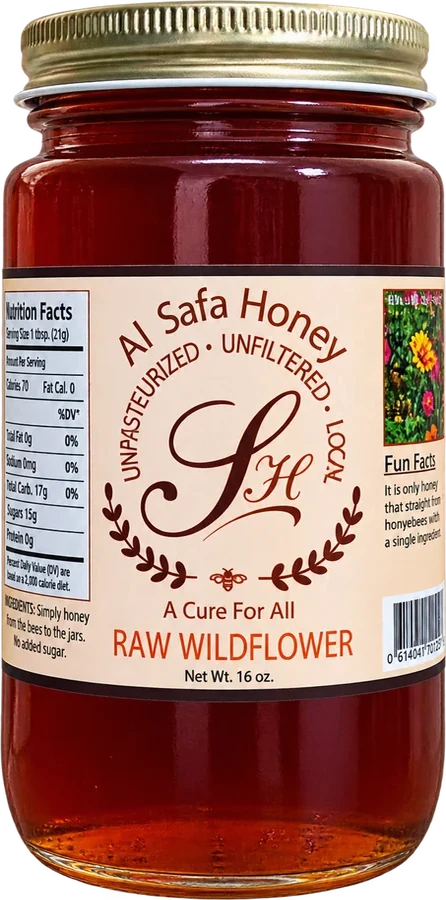
Six of our honeys are New York State harvested, our knotweed comes from North Dakota and our orange blossom from Florida. Try a single jar like Raw Wildflower Honey or save with a 3 or 6 jar pack in our shop.
Sources
Outside health sources we used for this article. They open in a new tab.
- Honey as Nutrient and Functional Food · Bee Product Science (Stefan Bogdanov)
- Biochemical Reactions and Their Biological Contributions in Honey · Molecules (via National Library of Medicine)
- FY21/22 Sample Collection and Analysis of Imported Honey for Economically Motivated Adulteration · U.S. Food and Drug Administration
Frequently asked questions
- What does proline in honey indicate?
- It is mainly used as a sign of ripeness and authenticity. Very low levels can point to honey harvested too early or mixed with sugar syrup.
- Is proline in honey from the bees or the flowers?
- Both contribute, but most of it is believed to come from bee secretions added during ripening.
- Can I test proline in honey at home?
- No. It requires a laboratory method. Home tests like the water or flame test are not reliable for proline or authenticity.
- Is honey a good source of amino acids?
- No. Honey contains only about half a gram of protein and amino acids per 100 grams. It is valued for flavor, not protein.
- Does heating honey destroy proline?
- Proline is more stable than enzymes, but heat and long storage can reduce it and also cause other quality changes, which is why raw honey is gently handled.
- Where does Al Safa honey come from?
- Our honey comes from a partner farm. Six varieties are New York State harvested, knotweed is from North Dakota and orange blossom is from Florida.
Al Safa Honey is a food producer, not a medical provider. Nothing here is medical advice, and these statements have not been evaluated by the Food and Drug Administration. Talk to your doctor about any health concern. Never give honey of any kind to a baby under 12 months old.