Honey for Sleep: A Calm Bedtime Ritual and What the Evidence Shows
A warm mug of milk or tea with honey is a bedtime tradition in many homes, and it is easy to see why: it is comforting, simple and sweet. Online, you will also find bold claims that honey can transform your sleep. The research is much more modest than that. This article looks at what studies have actually measured, how honey might fit into a relaxing evening routine, and when trouble sleeping deserves a conversation with your doctor.
Where the honey and sleep idea comes from
Some of the strongest evidence connecting honey and sleep actually comes from cough research. In a placebo-controlled trial of 300 children aged one to five with colds, a dose of honey given before bed was linked to less nighttime coughing and better sleep for both children and their parents. In that case, the improved sleep appears to come from quieter coughing, not from honey acting as a sedative.
Healthline's article on honey and milk describes a small study of people hospitalized with heart disease, in which a milk and honey drink taken twice daily for three days was associated with better sleep quality. That is a specific group, a short study and a combined drink, so it cannot tell us much about honey alone in healthy sleepers.
A 2024 review exploring honey as a functional food for natural sleep support discusses possible mechanisms and calls for more research. It reflects scientific curiosity, not settled evidence.
Possible reasons a bedtime spoonful feels calming
Researchers have suggested a few ideas. A small amount of carbohydrate in the evening may help the brain take up tryptophan, an amino acid used to make serotonin and melatonin. Others point out that honey provides a modest amount of energy the liver can store overnight. These theories are often repeated online, but they have not been well tested in people eating normal amounts of honey.
The most reliable reason may be the simplest. A warm, sweet drink sipped slowly in a quiet room is a cue to wind down. Rituals like this can help signal the end of the day, and that predictability is a core part of good sleep habits.
A simple honey bedtime ritual
If you enjoy the idea, keep the portion small and the routine gentle. A teaspoon of honey is plenty, and it pairs naturally with caffeine-free drinks. Mild, light honeys tend to suit evening drinks best because they sweeten without overpowering delicate flavors like chamomile.
- Warm milk or a milk alternative with a teaspoon of honey and a pinch of cinnamon
- Chamomile or lemon balm tea, cooled slightly, with orange blossom honey
- A spoonful of honey on its own, followed by brushing your teeth
- Dim the lights and put screens away while you sip
Habits with stronger evidence
Honey works best as a small part of a broader routine. Habits with much better support include keeping a regular sleep and wake time, getting daylight in the morning, limiting caffeine after midday, avoiding heavy meals and alcohol close to bedtime, and keeping the bedroom cool, dark and quiet.
If you regularly struggle to fall asleep or stay asleep, snore loudly, or feel exhausted during the day despite enough time in bed, talk to your doctor. Conditions such as insomnia, sleep apnea and restless legs syndrome are common and can be addressed properly. People with diabetes should also ask their doctor before adding sweet drinks at night.
Choosing a honey for evening drinks
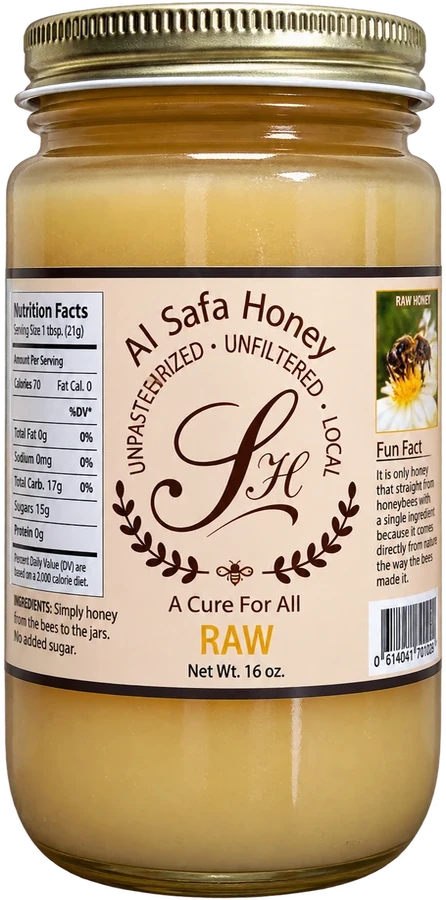
Light honeys like our Raw Clover Honey and Raw Orange Blossom Honey have soft floral notes that complement milk and herbal tea. Al Safa honeys are raw, unpasteurized and strained of wax only, so each jar tastes of its flowers. If a jar has crystallized, a spoonful dissolves easily into a warm drink.
One firm rule for families: never give honey to babies under 12 months old, even a small taste in warm milk at bedtime, because of the risk of infant botulism. From age one, a little honey in a bedtime drink is generally fine, followed by tooth brushing.
Sources
Outside health sources we used for this article. They open in a new tab.
- Effect of honey on nocturnal cough and sleep quality: a double-blind, randomized, placebo-controlled study · PubMed
- Exploring honey's potential as a functional food for natural sleep aid · PubMed
- Honey and Milk: Benefits and Drawbacks · Healthline
- Foods and Drinks to Avoid or Limit (infants and toddlers) · Centers for Disease Control and Prevention
Frequently asked questions
- Does honey help you sleep?
- There is limited evidence. Studies suggest honey may improve sleep in children with nighttime coughs, and a small study in heart patients found better sleep with milk and honey. Research in healthy adults is lacking, so honey is best seen as part of a calming routine, not a sleep aid.
- How much honey should I have before bed?
- A teaspoon is a sensible amount. Honey is added sugar, so keep the portion small and brush your teeth afterward.
- Can I put honey in my baby's bedtime milk?
- No. Honey must never be given to babies under 12 months old because it can cause infant botulism. Talk to your pediatrician about baby sleep concerns.
- Is honey safe at night if I have diabetes?
- Honey raises blood sugar like other sugars. If you have diabetes, ask your doctor or dietitian whether a bedtime drink with honey fits your plan and how to count it.
Al Safa Honey is a food producer, not a medical provider. Nothing here is medical advice, and these statements have not been evaluated by the Food and Drug Administration. Talk to your doctor about any health concern. Never give honey of any kind to a baby under 12 months old.