Why Babies Can't Have Honey: Infant Botulism Explained for Parents
The reason why babies can't have honey is infant botulism, a rare but serious illness caused by bacterial spores that a baby's immature gut cannot yet keep in check. The rule is simple and has no exceptions: no honey of any kind before a child's first birthday. This page explains the biology, what to watch for, and the gray areas parents ask about most.
Why babies can't have honey: the short biology
Clostridium botulinum is a bacterium that lives in soil and dust worldwide. In its dormant form it exists as spores, tough capsules that survive drying, freezing and ordinary cooking. Bees pick up these spores along with nectar and pollen, so a small share of honey contains them.
In older children and adults, an established community of gut bacteria crowds out the spores and they pass through harmlessly. A baby's gut is still being colonized in the first year, so spores can sprout, multiply in the intestine and produce botulinum toxin. That toxin blocks the signals between nerves and muscles.
Does raw or pasteurized honey make a difference?
No. Commercial pasteurization heats honey to roughly 145 to 160°F, which is far too gentle to destroy botulism spores. Destroying them reliably takes about 250°F under pressure, the conditions of a commercial canning retort, and no honey is processed that way.
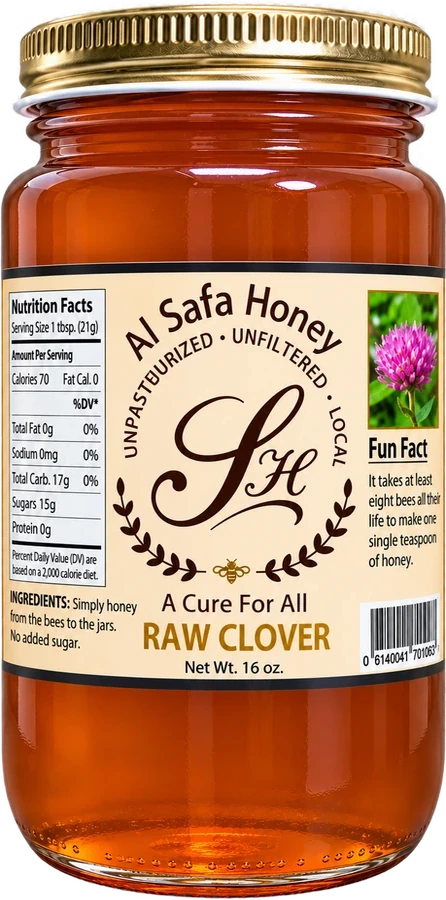
So the rule applies equally to raw honey, supermarket honey, organic honey, manuka and honey from any source, including Al Safa's. Labels on honey sold in the U.S. often carry a reminder for exactly this reason.
Signs of infant botulism to know
Symptoms usually appear between 3 and 30 days after a baby swallows spores. They tend to start quietly and build over several days, which is why parents sometimes notice the pattern only in hindsight.
If you see several of these together, call your pediatrician the same day or go to an emergency room. Infant botulism is treatable in the hospital, and early treatment shortens recovery.
- Constipation, often the very first sign, with fewer bowel movements than normal for three days or more
- Weak sucking and poor feeding, or milk leaking from the mouth
- A weak or unusually quiet cry
- Drooping eyelids and a flat, less expressive face
- Floppiness, poor head control or a baby who feels limp when lifted
- Trouble breathing, which needs emergency care right away
Baked goods, cereals and other gray areas
Baking does not make homemade honey treats safe for babies. The inside of a muffin or loaf only reaches about 200 to 210°F, short of what spores need, so the standard advice from pediatric groups is to avoid honey in any form, including baked into foods, before 12 months.
Commercially made foods such as honey graham crackers or honey-flavored cereals are a question pediatricians answer differently, since industrial processing varies. The cautious course is to skip them until the first birthday and ask your pediatrician if a specific product comes up.
The same rule covers honey on pacifiers, honey water for colic and honey in teething remedies, all of which were once common advice and are now firmly discouraged.
Honey is one source, not the only one
Most infant botulism cases reported in the U.S. have no link to honey at all. Babies usually swallow spores from soil and household dust, especially near construction or farmed land. That is not a reason to worry about every speck of dust; it is a reason honey, the one avoidable source, is off the menu.
Infant botulism remains uncommon, yet it accounts for most of the botulism cases the CDC records each year. Avoiding honey is one of the few concrete steps parents can take against it.
Introducing honey after 12 months
From the first birthday onward, a toddler's gut can handle spores the way an adult's does. Start with a small amount, about 1/2 teaspoon stirred into yogurt or oatmeal, as you would any new food.
Remember that honey is still added sugar. Pediatric guidance suggests keeping added sugars low for toddlers, so treat honey as an occasional flavor. A mild honey such as raw clover is an easy first taste.
Frequently asked questions
- What if my baby accidentally ate a little honey?
- Do not panic; most babies who swallow honey do not get sick. Watch closely for the signs above over the next month, especially constipation and weak feeding. Tell your pediatrician what happened so they can advise you.
- Can I eat honey while breastfeeding?
- Yes. Botulism spores and toxin are not known to pass into breast milk, so a nursing parent can eat honey normally. The risk comes only from the baby swallowing honey directly.
- Is honey safe at exactly 12 months, or should I wait longer?
- Major pediatric guidance sets the line at 12 months. By then the gut microbiome is developed enough to stop spores from growing. There is no need to wait longer unless your pediatrician advises it for another reason.
- How is infant botulism treated?
- Babies are cared for in the hospital, often with an antitoxin made specifically for infants and support for feeding and breathing while muscle strength returns. Most recover fully, though it can take weeks.
- Are other sweeteners like maple syrup safe for babies?
- Maple syrup does not carry the same spore warning, but pediatric advice is to avoid all added sugars before age 2. Sweetness is not something a baby needs.
- Should honey be kept away from babies' older siblings' foods too?
- Older children can eat honey freely; the concern is only what reaches the baby's mouth. Watch for shared spoons, sticky fingers and toddlers offering bites of honey toast. Wiping counters and high-chair trays after honey-heavy meals is a sensible habit while there is an infant at the table.
Al Safa Honey is a food producer, not a medical provider. Nothing here is medical advice. Never give honey of any kind to a baby under 12 months old.