Honey Science & Purity
Honey in the First Aid Tin: A Four-Thousand-Year Tradition
Al Safa HoneyOctober 16, 20266 min read
There is a category of modern wound dressing, sold through pharmacies and used in hospitals, whose active ingredient is honey. That alone should tell you the tradition is not superstition — and it should also tell you something important about why your kitchen jar is not the same product.
Why honey behaves the way it does on skin
Three properties do most of the work. Honey's extremely low free-water content draws moisture osmotically. Its natural pH sits in the acidic range. And raw honey carries bee-contributed glucose oxidase, which generates trace hydrogen peroxide as honey is diluted.
Together those are also the reasons honey does not spoil in a jar on your shelf without a single preservative added.
Medical-grade honey is a manufactured product
The honey in a clinical dressing is sourced to specification, filtered, standardised and gamma-irradiated to eliminate spores while preserving activity, then packaged sterile. It is a regulated medical device.
A jar of raw table honey is a food. It is not sterile and it is not standardised. That distinction matters, and we would rather state it plainly than let the research halo do our selling.
What belongs where
Deep wounds, burns, anything that will not stop bleeding, anything in a diabetic foot, and any wound showing signs of infection: clinician, immediately. Not a kitchen cupboard.
Where raw honey earns its long domestic history is the gentle end — dry hands after a winter of washing, chapped lips, rough elbows, a dry patch on a heel. Cosmetic comfort, not treatment.
Why the house harvest
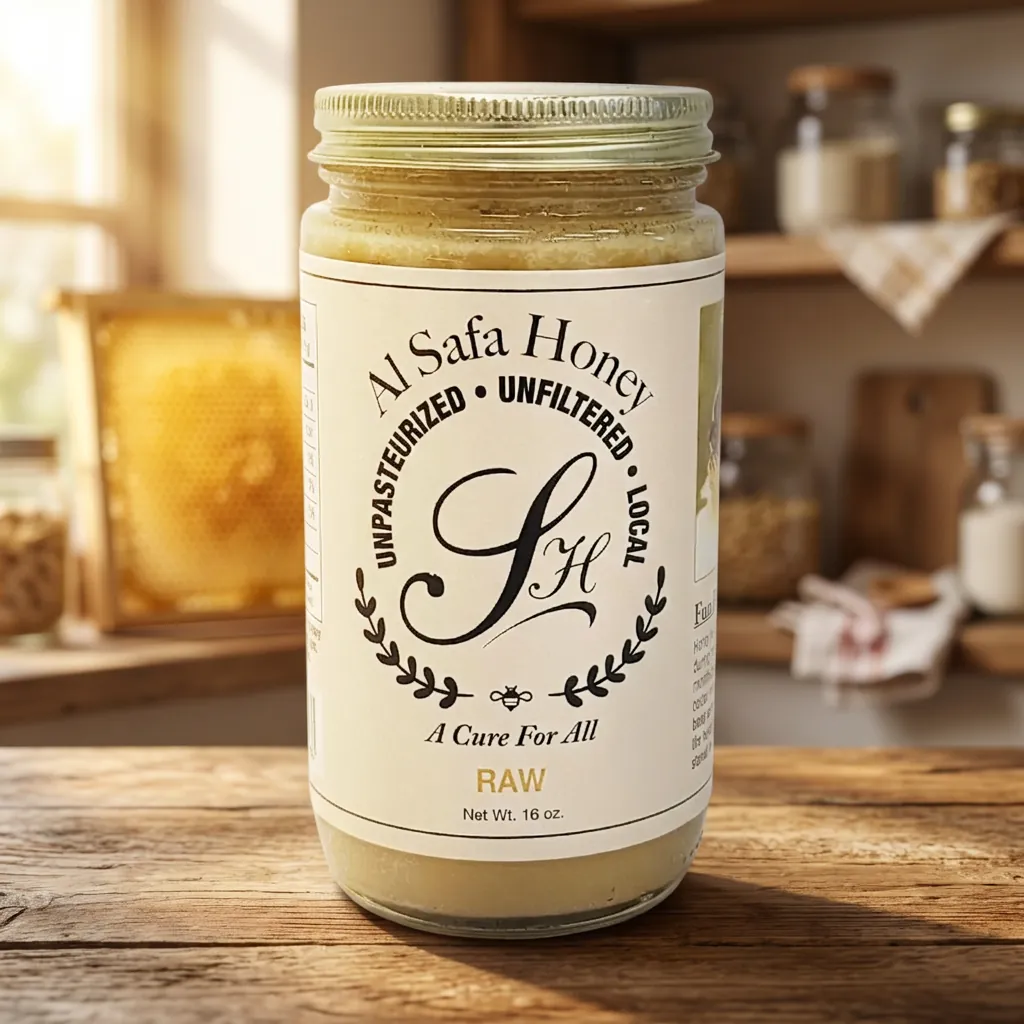
Pure Raw Honey is our mixed-bloom American harvest: cold-extracted, unfiltered, balanced and bottled with nothing removed. It is our most practical jar for both the table and the occasional dab on dry skin.
Full disclosure, repeated once more: it is food, bottled as food, and that is how it should be used.
The ritual
The Overnight Honey Hand Salve
For dry winter hands. Nothing but honey, a warm cloth and a pair of cotton gloves.
- 1Wash and dry your hands, then massage a thin layer of Pure Raw Honey over the dry areas — knuckles, cuticles, the backs of the hands.
- 2Leave it on for ten minutes while it draws moisture in.
- 3Rinse with warm water and pat dry. For an overnight version, rinse lightly and pull on clean cotton gloves.
- 4Skip it on any broken, weeping or painful skin — that is a doctor's territory, not honey's.
Questions we get asked
- Is kitchen honey the same as medical honey dressings?
- No. Clinical honey dressings are standardised, sterilised medical devices. Table honey, however raw and pure, is a food and is neither sterile nor standardised.
- Can I put raw honey on a cut or burn?
- Open wounds, burns and any wound showing infection should be treated by a clinician. Raw honey's place at home is cosmetic comfort on intact dry skin.
- Why does honey never spoil?
- Very low free-water content, natural acidity, and the trace hydrogen peroxide generated by bee-contributed enzymes together make honey extraordinarily shelf-stable without preservatives.
Al Safa Honey is a food producer, not a medical provider. Nothing here is medical advice or a treatment for any condition — speak with your own doctor about your health, and never give honey of any kind to an infant under one year of age.
100% raw & unfiltered
Cold-extracted, never heated above hive temperature. Natural pollen intact.
Secure encrypted checkout
256-bit encryption with Shop Pay, Apple Pay and Google Pay verification.
Fast U.S. shipping
Packed by hand and shipped from New Jersey. Free on orders over $50.
Cancel any time
Skip a shipment, swap your harvest or cancel in one tap. No contracts.