Knotweed vs Buckwheat Honey: Two Dark Honeys Side by Side
Knotweed vs buckwheat honey is the comparison dark-honey lovers ask about most. Both are bold, full-bodied and far from the mild golden honey most people know. Buckwheat honey is near-black and malty, made from a summer crop. Knotweed honey is dark amber with a resinous, herbal depth, made from one of the last blooms of autumn. This article compares knotweed vs buckwheat honey on color, flavor, season, texture and uses, so you can decide which bold jar suits your kitchen. For a gentler comparison, see buckwheat vs wildflower honey.
For general education only, not medical advice. Our honey is a food and is not intended to diagnose, treat, cure or prevent any disease.
Two late, dark harvests
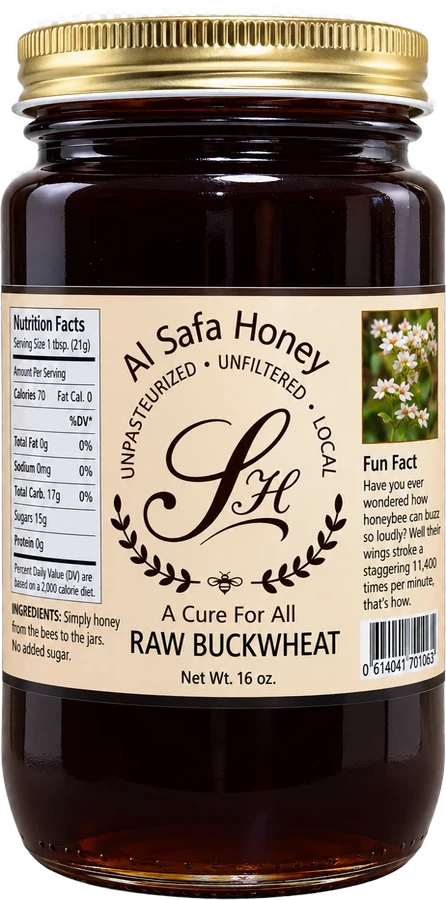
Buckwheat is a fast-growing crop with clusters of small white flowers, planted in many northern farming regions. It blooms in mid to late summer, and bees working those fields make a very dark, distinctive honey.
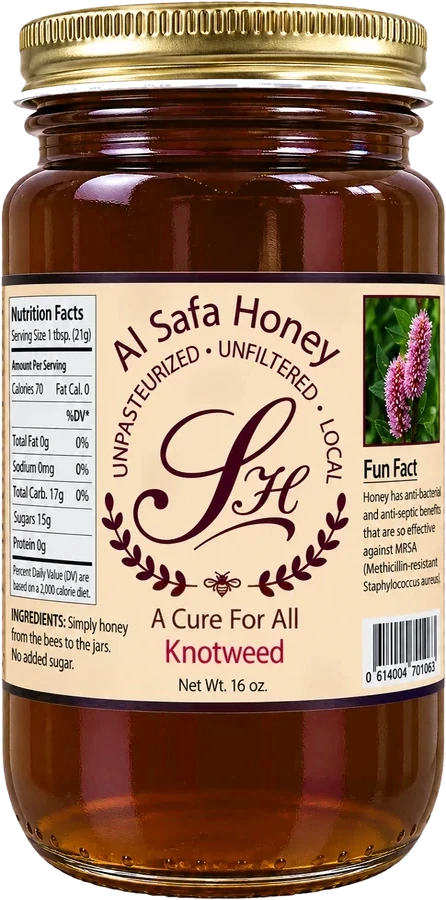
Knotweed blooms even later, sending up creamy plumes along riverbanks and field edges in early autumn, when most other nectar has dried up. Beekeepers value it as a last strong flow before winter. The honey it produces is dark, rich and unlike most others.
Knotweed vs buckwheat honey at a glance
The key differences:
| Feature | Knotweed honey | Buckwheat honey |
|---|---|---|
| Color | Dark amber | Near-black, deep mahogany |
| Aroma | Herbal, resinous, autumnal | Malty, earthy, molasses |
| Body | Full-bodied | Thick and heavy |
| Bloom | Early autumn | Mid to late summer |
| Intensity | Robust | Very robust |
How they taste
Buckwheat honey tastes malty and earthy, with notes often compared to molasses, dark caramel, pumpernickel or even a farmyard. Its flavor lingers long after you swallow. It can be polarizing: people tend to love it or need time to warm up to it.
Knotweed honey is bold too, but its character leans herbal and resinous rather than earthy. Many tasters describe hints of dark fruit, spice and toasted grain, with a smoother finish than buckwheat. For some people, it is an easier first step into dark honey.
Color on the honey scale
Both sit at the dark end of the USDA honey color scale. Buckwheat is usually the darker of the two, often almost opaque in the jar. Knotweed glows a deep reddish amber when held to the light.
Phenolic compounds in dark honey
Research has consistently found that darker honeys tend to contain more phenolic compounds and show stronger antioxidant activity in lab tests than lighter honeys, as summarized in a review of honey composition. Buckwheat honey is one of the most studied dark honeys.
Lab scores do not equal effects in the body, so choose based on taste and use. Our article on honey antioxidants has more background.
Best uses for buckwheat honey
Buckwheat honey's molasses depth is perfect in gingerbread, rye and pumpernickel breads, baked beans, barbecue sauce and glazes for pork or beef. It pairs beautifully with blue cheese and aged cheddar, and it holds its own in strong coffee.
- Gingerbread and spice cakes
- Baked beans and barbecue sauce
- Blue cheese
- Strong coffee
Best uses for knotweed honey
Knotweed honey shines with strong black tea, chai and coffee, and in savory glazes for roasted carrots, squash, root vegetables and lamb. A spoonful in warm water with lemon and ginger is a cozy cold-season drink. It also pairs well with aged gouda and manchego.
Our article on honey and rosemary has glaze recipes that suit knotweed perfectly.
A dark honey flight
Set out a slice of aged cheese, a few walnuts and two small spoons, one of each honey. Taste knotweed first, then buckwheat, since buckwheat's flavor lingers longer. Notice how knotweed's herbal notes play with the nuts, while buckwheat's maltiness deepens the cheese.
Texture and crystallizing
Both are thick, full-bodied honeys. Buckwheat often crystallizes into a dense, fudge-like set. Knotweed's crystallizing varies but tends to be smooth. Warm either gently in a bowl of warm water to make it pourable again.
Our knotweed and buckwheat honeys
Raw Knotweed Honey is harvested in North Dakota from the late-autumn knotweed bloom, once a year. Raw Buckwheat Honey is harvested in New York State, near-black, malted and earthy. Both are cold-extracted and never heated above hive temperature, with the natural pollen left in.
Cooking tip for dark honeys
Dark honeys can taste bitter if scorched, so add them late to glazes and sauces. In baking, lower the oven by about 25°F when using honey in place of sugar. Our baking with honey guide explains the swap.
Who should pick which
Pick buckwheat if you love molasses, dark rye and intense flavors, or want the classic dark honey for winter baking. Pick knotweed if you want a bold honey with herbal, aromatic character that is a touch smoother. Fans of one usually enjoy the other.
The takeaway on knotweed vs buckwheat honey
Knotweed vs buckwheat honey is a contest between two bold, dark jars. Buckwheat is earthier and maltier; knotweed is more herbal and resinous. Both are wonderful in strong tea, glazes and with aged cheese.
Knotweed vs buckwheat honey in winter drinks
On cold evenings, both dark honeys make warming drinks. Stir knotweed honey into hot water with lemon and sliced ginger for a fragrant, herbal mug. Buckwheat honey is wonderful in a spiced milk with cinnamon and nutmeg, where its malty notes taste almost like a malted drink. Add the honey once the liquid has cooled slightly so its aroma stays bright.
Taste the dark side
Order Raw Knotweed Honey and Raw Buckwheat Honey for your own comparison. Save with a 3 jar or 6 jar pack of any honey, and orders over $50 ship free. Visit our shop.
Sources
Outside health sources we used for this article. They open in a new tab.
- United States Standards for Grades of Extracted Honey · USDA Agricultural Marketing Service
- Contribution of honey in nutrition and human health: a review · Universidad San Francisco de Quito (Mediterranean Journal of Nutrition and Metabolism)
- Honey as Nutrient and Functional Food · Bee Product Science (Stefan Bogdanov)
Frequently asked questions
- What is the difference between knotweed and buckwheat honey?
- Buckwheat is malty and earthy; knotweed is herbal and resinous.
- Which honey is darker?
- Buckwheat is usually darker, often near-black.
- Is knotweed honey good for tea?
- Yes. It holds up well in strong black tea and chai.
- Where is Al Safa's knotweed honey from?
- North Dakota.
- Where is Al Safa's buckwheat honey from?
- New York State.
- Which dark honey is easier for beginners?
- Many find knotweed a little smoother than buckwheat.
- Do dark honeys have more antioxidants?
- Darker honeys tend to show more phenolic compounds in lab tests.
Al Safa Honey is a food producer, not a medical provider. Nothing here is medical advice, and these statements have not been evaluated by the Food and Drug Administration. Talk to your doctor about any health concern. Never give honey of any kind to a baby under 12 months old.