Minerals in Honey: Potassium, Iron, Zinc and What Dark Honey Adds
Minerals in honey are often listed on wellness websites as if honey were a multivitamin. The truth is more modest and, in its own way, more interesting. Honey does contain potassium, calcium, magnesium, iron, zinc and other trace elements, and dark honeys carry noticeably more than light ones. But the amounts in a normal serving are small. This article gives real numbers for the minerals in honey, explains why color matters and shows how honey compares with everyday foods. For the full nutrition label, see honey nutrition facts.
For general education only, not medical advice. Our honey is a food and is not intended to diagnose, treat, cure or prevent any disease.
Which minerals in honey are present
USDA FoodData Central lists honey with about 52 mg of potassium, 6 mg of calcium, 2 mg of magnesium, 4 mg of phosphorus and 0.4 mg of iron per 100 grams. Those are average values for a generic honey.
Real honeys vary a lot. Stefan Bogdanov's review of honey as a food reports potassium ranging from about 40 mg to as much as 3,500 mg per 100 grams across honey types, with dark honeys at the high end.
Trace elements such as zinc, copper, manganese and selenium also appear in small amounts. Their levels reflect the soil and plants the bees visited.
| Mineral | Per 100 g (USDA average) | Per tablespoon (21 g) |
|---|---|---|
| Potassium | About 52 mg | About 11 mg |
| Calcium | About 6 mg | About 1 mg |
| Phosphorus | About 4 mg | Under 1 mg |
| Magnesium | About 2 mg | Under 1 mg |
| Iron | About 0.4 mg | Under 0.1 mg |
Why dark honey has more minerals in honey
One of the most consistent findings in honey research is that color tracks mineral content. Darker honeys tend to hold more potassium and trace elements, and they also tend to have higher electrical conductivity, a lab measure linked to minerals.
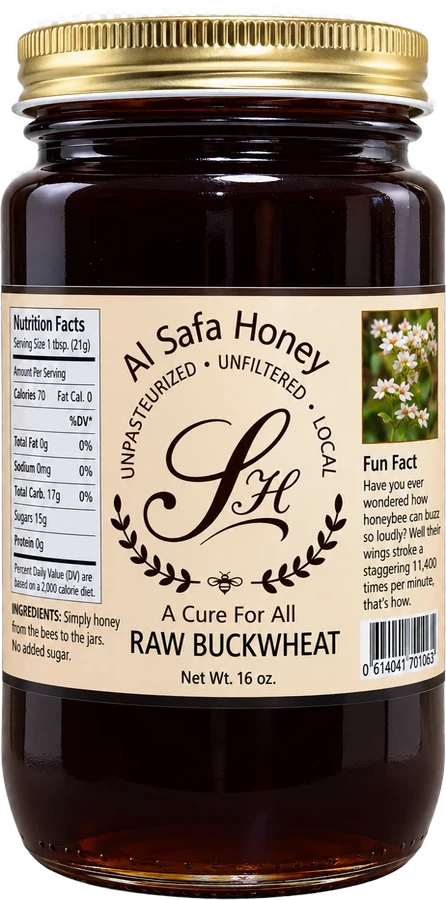
Buckwheat honey and honeydew honey usually sit near the top. Pale honeys such as clover, orange blossom and acacia usually sit near the bottom. Our article on dark honey benefits explores this further.
Researchers even use minerals in honey to help confirm where it came from, because soil and plant chemistry leave a regional fingerprint.
How honey compares with everyday foods
Even a mineral-rich dark honey is a small source compared with whole foods. A medium banana has around 400 mg of potassium. A cup of cooked spinach brings plenty of magnesium and iron. A handful of almonds supplies calcium and magnesium.
Honey's role is better described as a flavorful sweetener that happens to carry traces of minerals, unlike refined white sugar, which carries almost none.
- Banana: about 400 mg potassium
- Plain yogurt, 1 cup: about 400 mg calcium
- Pumpkin seeds, 1 ounce: about 150 mg magnesium
- Lentils, 1 cup cooked: about 6 mg iron
- Honey, 1 tablespoon: traces of each
Minerals in honey versus white sugar
If you are choosing between honey and white sugar for a recipe, minerals in honey are a small point in honey's favor. Both are added sugars in nutrition terms, and the American Heart Association recommends limiting added sugars of every kind.
Harvard Health notes that the differences between sweeteners are modest. Choosing honey for its taste, and using a little less because it is sweeter, is a sensible approach.
Do minerals in honey change with processing?
Minerals are stable. Unlike enzymes, they are not damaged by heat. Filtering and blending can still change the overall profile, because they mix honeys from different sources and remove pollen and particles.
Raw honey that is strained only of wax keeps the natural mineral fingerprint of its floral source. That is part of why single-origin honeys taste so different from each other.
Trace minerals in honey and the environment
Because bees forage over a wide area, minerals in honey reflect the landscape around the hive. Researchers have used honey as a way to monitor trace elements in the environment, since soil and air both leave traces in nectar and on plant surfaces.
A 2025 review titled Honey: Inorganic Composition as Possible Marker for Botanical and Geological Assignment describes how mineral patterns can help link honey to both its plants and its geology.
For shoppers, this is a reminder that single-origin honey really does carry a sense of place, down to the minerals in the soil.
Minerals in honey at a glance
A quick summary of what to remember:
- Potassium is the most abundant of the minerals in honey.
- Dark honeys generally carry more minerals than light honeys.
- A tablespoon provides only small amounts of any mineral.
- Minerals are stable and are not damaged by heat.
- Mineral patterns help experts identify where honey came from.
Enjoying darker honeys
If minerals in honey interest you, darker jars are the ones to explore. Raw Buckwheat Honey is near-black, malty and earthy. Raw Knotweed Honey is a full-bodied late-season honey with herbal depth.
Both pair beautifully with aged cheese, rye bread and black tea. Buy a 3 or 6 jar pack to save, and enjoy free shipping on orders over $50 in our shop.
Sources
Outside health sources we used for this article. They open in a new tab.
- Honey: nutrient profile · USDA FoodData Central
- Honey as Nutrient and Functional Food · Bee Product Science (Stefan Bogdanov)
- Honey: Inorganic Composition as Possible Marker for Botanical and Geological Assignment · National Library of Medicine (PMC)
- Are certain types of sugars healthier than others? · Harvard Health Publishing
Frequently asked questions
- What is the main mineral in honey?
- Potassium. It is the most abundant of the minerals in honey, though amounts vary widely between floral sources.
- Does dark honey have more minerals?
- Generally yes. Darker honeys such as buckwheat and honeydew usually contain more minerals than pale honeys.
- Is honey a good source of iron?
- No. A tablespoon contains well under a tenth of a milligram on average. Beans, lentils, leafy greens and meat are far better sources.
- Does raw honey have more minerals than processed honey?
- Minerals depend mainly on floral source. Raw honey keeps its natural profile, while blending and filtering can change it.
- Can minerals in honey show where it came from?
- Yes. Researchers use mineral fingerprints, along with pollen and other markers, to help identify a honey's origin.
- Which Al Safa honey is darkest?
- Raw Buckwheat Honey is our darkest, followed by Raw Knotweed Honey.
Al Safa Honey is a food producer, not a medical provider. Nothing here is medical advice, and these statements have not been evaluated by the Food and Drug Administration. Talk to your doctor about any health concern. Never give honey of any kind to a baby under 12 months old.