How Is Honey Made? From Flower Nectar to the Jar
How is honey made? It starts as watery flower nectar, often more than 70 percent water, and ends as a thick, shelf-stable food with less than 20 percent water that can keep for years. Bees do the transformation with enzymes, teamwork and a lot of fanning; beekeepers then remove the surplus, spin it out of the comb and strain it into jars. This guide follows both halves of the journey, and explains where the word raw fits in.
Step 1: Bees collect nectar from flowers
Nectar is a sugary liquid that flowers produce to attract pollinators. Its makeup varies by plant: some nectars are mostly sucrose, some mostly glucose and fructose, and all contain trace minerals, acids and aromatic compounds that will eventually become the honey's flavor. Water content is high, typically 40 to 80 percent.
Forager bees, the oldest workers in the colony, fly out to find it. A forager pushes her tongue, called a proboscis, into the flower and sucks the nectar into a special organ called the honey stomach or crop, separate from the stomach she uses to feed herself. A full load can weigh nearly as much as she does, and filling it may take visits to a hundred flowers or more.
Bees tend to stay loyal to one kind of flower on each trip, a behavior called flower constancy. That is what makes single-flower honeys like clover or buckwheat possible: when one plant dominates the landscape, foragers keep bringing back the same nectar.
Step 2: Enzymes start turning nectar into honey
The chemistry begins before the bee even gets home. Glands in her head add an enzyme called invertase to the nectar in her crop, which starts splitting sucrose into two simpler sugars, glucose and fructose. This is why honey is mostly those two sugars rather than table sugar.
Back at the hive, the forager passes her load mouth to mouth to younger house bees, a process called trophallaxis. Each bee adds more enzymes as the nectar moves along. One of these, glucose oxidase, converts a little glucose into gluconic acid and hydrogen peroxide. The acid gives honey its mild tartness and low pH, and together these help protect the finished honey from spoilage.
Step 3: Evaporation and capping in the hive
Enzymes alone do not make honey; it also has to lose most of its water. House bees spread the nectar in thin layers across the wax cells and repeatedly hold droplets on their tongues to expose them to air. Thousands of bees fan their wings in coordinated lines to pull warm, dry air through the hive, which is kept at around 93 to 95 degrees Fahrenheit near the brood.
Over several days the moisture drops from as much as 70 percent to about 17 or 18 percent. At that point the sugar concentration is so high that yeasts and bacteria cannot grow. When a cell is ripe, bees seal it with a fresh cap of white beeswax, made from glands on their abdomens. A capped frame is the beekeeper's signal that the honey is finished.
The numbers are remarkable. To make one pound of honey, a colony's foragers may fly tens of thousands of miles combined and visit millions of flowers. A single worker produces only about a twelfth of a teaspoon in her lifetime.
- Nectar arrives: roughly 40 to 80 percent water, often sucrose-rich.
- Enzymes added: invertase splits sucrose; glucose oxidase adds acidity.
- Spread and fanned: water evaporates over a few days.
- Ripe honey: about 17 to 18 percent water.
- Capped: sealed in wax for storage until needed.
How is honey made ready for the jar? The beekeeper's harvest
A strong colony in a good season makes far more honey than it needs, and beekeepers stack extra boxes, called supers, on top of the hive for that surplus. Responsible beekeepers harvest only from these upper boxes and leave the colony enough honey to get through winter, which in a northern climate can mean 60 pounds or more.
To harvest, the beekeeper first clears bees from the supers. Common methods include a one-way bee escape board placed the day before, a gentle blower, or a fume pad with a scent bees dislike. Smoke calms the bees while the hive is open. Only frames that are mostly capped are taken, because uncapped honey may still be too wet and could ferment.
Timing depends on the bloom. Beekeepers who want a single-flower honey harvest right after that plant finishes flowering, before bees switch to the next source. Others harvest once or twice a season for a mixed wildflower honey.
A typical season might look like this in a northern state: colonies build up on spring blossoms such as dandelion, willow and fruit trees, mostly feeding their own brood; supers go on as the main summer flows of clover, basswood or a field crop begin; the beekeeper pulls honey in midsummer and again in late summer; and whatever the bees store from goldenrod and aster in fall is left for them to eat over winter.
How honey is extracted from the comb
In the honey house, each frame is uncapped with a heated knife, a serrated fork or an uncapping machine that shaves off the thin wax seal. The frames go into an extractor, a drum that spins them so centrifugal force throws honey out of the cells while the comb stays intact. The empty comb returns to the hive, saving the bees the work of building new wax.
Honey runs out of the extractor through a coarse strainer that catches wax bits and the occasional bee. It then settles in a tank for a day or two, so air bubbles and fine wax rise to the top and can be skimmed. From there it is bottled. Some honey is instead sold as cut comb, where the beekeeper simply cuts squares of capped comb and packs them whole.
| Stage | Raw honey | Typical processed honey |
|---|---|---|
| Extraction | Spun from the comb without added heat | Spun, sometimes with warmed frames or tanks |
| Straining | Coarse strain to remove wax only | Fine or pressure filtration that removes most pollen |
| Heating | Kept near hive temperature | Heated, often to 145 to 160 degrees Fahrenheit or more |
| Blending | Often single harvest or source | Frequently blended from many sources |
| Result | Cloudier, aromatic, crystallizes naturally | Clear, uniform, stays liquid longer |
What raw means in the honey-making process
Everything up to extraction is the same for all real honey. The difference between raw and processed honey happens afterward. Raw honey is generally understood to mean honey that has not been heated beyond the warmth of a hive and has only been strained coarsely, so pollen, enzymes and aromatic compounds remain. There is no single federal definition, which is why it helps to know what a brand means by the word.
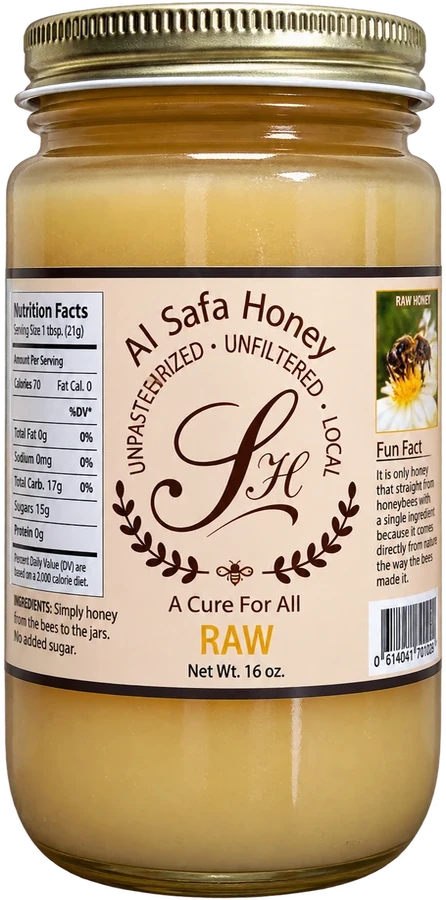
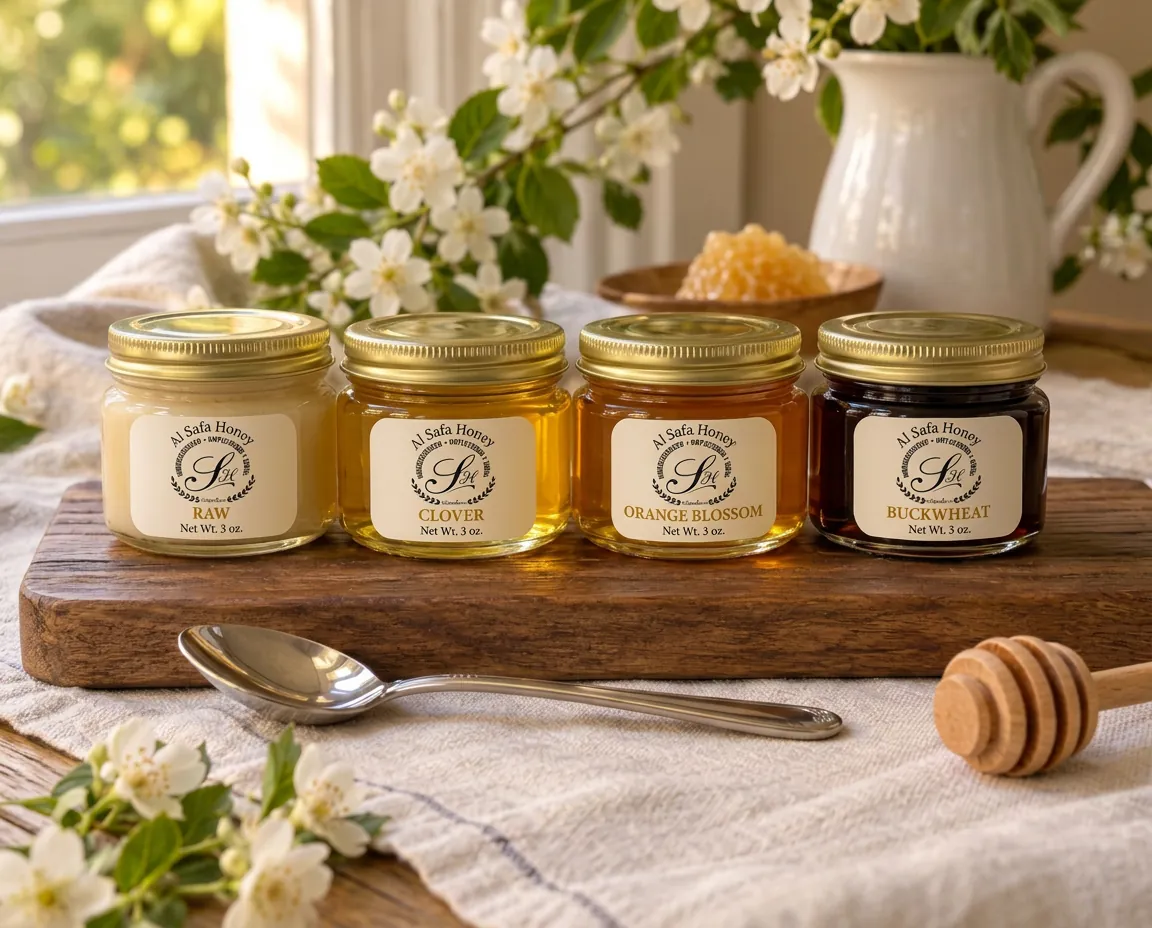
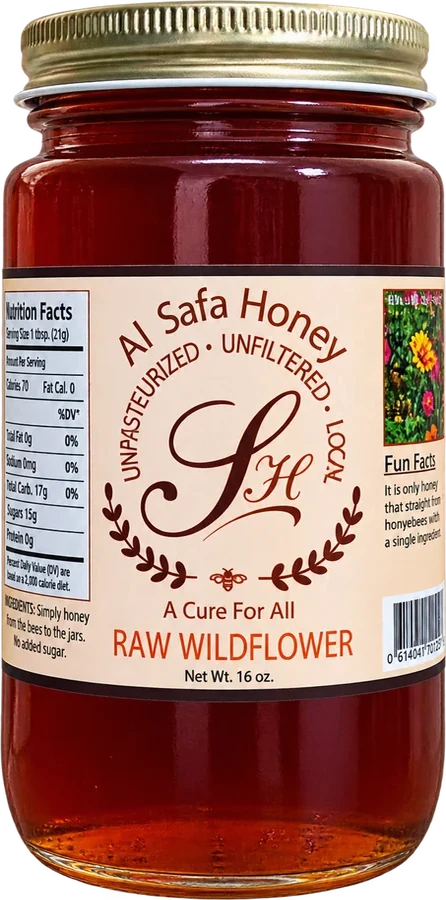
For Al Safa, raw means our partner beekeepers extract the honey cold, strain it of wax only, and leave it unpasteurized and unfiltered, with nothing added, before it goes into our 16 oz glass jars. Al Safa is a honey brand rather than a beekeeping operation, so the hive work described above is done by the beekeepers we source from. Our clover, wildflower, sunflower, blueberry blossom, buckwheat and house raw honeys are harvested in New York State, our knotweed in North Dakota, and our orange blossom in Florida.
As with every honey, raw or not, never give it to babies under 12 months.
Frequently asked questions
- Is honey bee vomit?
- Not really. Nectar is carried in the honey stomach, a storage organ separate from the bee's digestive stomach, and it never gets digested. It is closer to a carrying pouch than to vomit.
- How long does it take bees to make honey?
- Once nectar reaches the hive, ripening and capping usually take from a few days to about a week, depending on humidity and how much nectar is coming in. Filling a whole super can take weeks during a strong bloom.
- Do bees die when honey is harvested?
- A few bees are often lost during handling, even with careful technique. Good beekeepers clear bees from boxes first and work gently to keep losses low, and they leave enough honey for the colony.
- Why does honey from different flowers taste different?
- Each plant's nectar has its own mix of sugars, acids, minerals and aromatic compounds, and those carry through into the honey. That is why clover tastes mild and buckwheat tastes malty, even though bees process both the same way.
- Can honey be made without bees?
- Some companies make honey-like products from plant syrups or with fermentation, but under food labeling standards honey means the product made by honey bees. Anything else is an imitation or alternative, however it tastes.
Al Safa Honey is a food producer, not a medical provider. Nothing here is medical advice. Never give honey of any kind to a baby under 12 months old.