Is Honey Halal? What Islamic Tradition Says and What to Check
Is honey halal? For pure honey, Islamic scholars across the major schools of thought widely agree that it is: honey is a natural food made by bees, it is not slaughtered meat, and it holds an honored place in the Quran and the Hadith. Where questions arise is in what gets added to honey after it leaves the hive, such as flavorings, syrups or alcohol-based extracts. This guide explains why honey is considered halal, what can make a honey product questionable, and how to read a label with confidence. For any personal ruling, your local imam or a trusted scholar is the right authority.
Is honey halal in Islam?
In Islamic dietary law, foods are halal unless a clear reason makes them otherwise. The main prohibited categories are pork, blood, carrion, meat not slaughtered according to Islamic rules, and intoxicants. Honey belongs to none of these. It is made by living bees from flower nectar, and taking it does not involve slaughter.
A common question is whether honey is a problem because it comes from an insect, since many scholars consider most insects not permissible to eat. The answer generally given is that honey is a product of the bee, not the bee itself, in the same way that milk is a product of a cow. The texts that praise honey settle the matter for most scholars.
This is a general overview, not a religious ruling. Communities and scholars differ on details, especially about processed foods, so anyone with a specific concern should ask a qualified person they trust.
Honey in the Quran and Hadith
Honey has an unusually honored place in Islamic tradition. The sixteenth chapter of the Quran is named An-Nahl, The Bee. In verses 68 and 69, it describes how God inspired the bee to make its dwellings in mountains, trees and what people build, to eat of all the fruits and follow the paths of its Lord, and it says that from their bellies comes a drink of varying colors in which there is healing for people.
Honey is also mentioned among the rivers of Paradise in Surah Muhammad, described there as rivers of purified honey. In the Hadith collections, the Prophet Muhammad is reported to have loved honey and sweet things, and honey appears in several narrations as a food and a remedy.
The image of the bee itself carries meaning in this tradition. Commentators often point to the bee as an example of order, diligence and taking only what is good, since it gathers from flowers without destroying them and produces something beneficial for others.
Because of this, honey is a cherished food in many Muslim households and is often given as a gift, served to break the fast during Ramadan alongside dates, and offered to guests. Many families treat a good jar of honey as a small blessing on the table.
Islamic scholars and writers through the centuries, including physicians of the classical era, wrote about honey as food and as a traditional remedy. Modern readers should keep that history separate from medical advice: honey is a nourishing food, but questions about illness belong with a doctor, and that view sits comfortably alongside faith.
What can make a honey product questionable
Honey straight from the comb is simple. Problems, when they occur, come from processing and from what is added to make flavored or specialty products. These are the ingredients and practices worth watching for.
Adulteration is a separate issue but a real one: honey cut with cheap syrups is not haram in itself, yet it is dishonest, and trustworthiness in trade is a value Islamic ethics stresses. Buying pure honey from sources you trust addresses both concerns at once.
Processing aids deserve a brief mention. Some industrial honey is clarified or filtered with the help of materials that do not appear on the label because they are removed afterward. This is rare with raw honey, which is only strained, but it is one reason some buyers prefer minimally handled honey with a one-word ingredient list.
- Alcohol-based flavorings: vanilla extract and many natural flavors are made in alcohol, which some scholars consider problematic in food.
- Honey infused with liqueurs, bourbon or rum, or aged in spirit barrels.
- Gelatin, sometimes used in honey sweets, gummies or fining, which may come from pork or non-halal sources.
- Colorings such as carmine, made from insects, which some scholars avoid.
- Added syrups or sugars used to stretch honey, which raise honesty concerns.
- Honey sold with additives listed vaguely as flavors without a source.
Pure honey vs flavored honey products
The simplest rule of thumb is that the fewer ingredients a jar lists, the fewer questions it raises. A label that says only honey is about as straightforward as food gets. Honey spreads, honey sauces and flavored honeys deserve a closer look.
| Product | Typical ingredients | What to check |
|---|---|---|
| Pure raw honey | Honey only | Nothing added; buy from a trusted source |
| Creamed or whipped honey | Honey, sometimes seed crystals | Confirm no flavorings were added |
| Flavored honey (vanilla, cinnamon) | Honey plus spices or extracts | Whether extracts are alcohol-based |
| Spirit-infused or barrel-aged honey | Honey aged with alcohol | Generally avoided by observant Muslims |
| Honey candies and gummies | Honey, sugar, gelatin, colorings | Gelatin source and colorings |
| Honey syrup or blends | Honey plus corn or rice syrup | Honesty of labeling, sweetener sources |
Halal certification and how to read a label
Halal certification is a separate process run by certifying organizations, which inspect ingredients, equipment and facilities. For processed foods it gives useful assurance. For pure honey, many Muslims consider certification unnecessary because there is nothing to certify beyond the honey itself, while others prefer a certified product for peace of mind. Both approaches are common.
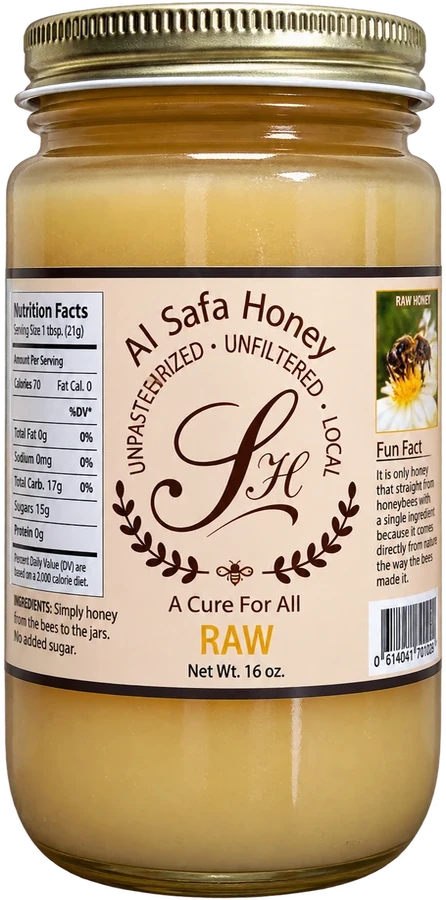
To be clear, Al Safa Honey does not hold halal certification, and we do not claim it. What we can describe is the product: our honey is pure raw honey with nothing added, no flavorings, no syrups and no alcohol. It is unpasteurized, strained only to remove bits of wax, and packed in 16 oz glass jars. The ingredient list is one word: honey. Whether that meets your standard is your decision to make, ideally with guidance from someone you trust.
When reading any honey label, look for a single ingredient, a clear floral source, and no vague references to natural flavors. If a product is flavored, contact the maker and ask how the flavor was made.
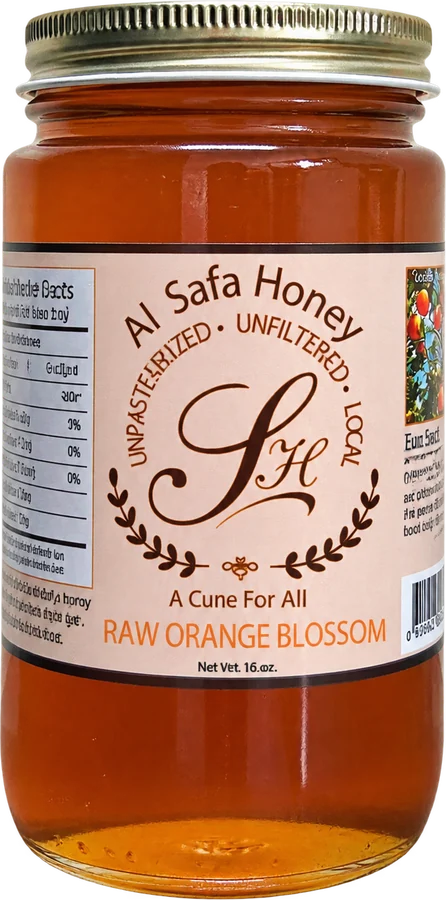
It also helps to know the source. A brand that can tell you the floral source, the region where the honey was harvested and how it was handled is usually one that pays attention to what goes into the jar. Our clover, wildflower, sunflower, blueberry blossom, buckwheat and house raw honeys are harvested in New York State by partner beekeepers, our knotweed in North Dakota and our orange blossom in Florida.
Choosing honey for Ramadan and gifting
Honey is a natural fit for iftar and suhoor. A spoonful with dates, stirred into warm tea, or drizzled over yogurt and bread gives quick energy after a long day of fasting. Lighter honeys like clover and orange blossom suit tea and pastries, while darker honeys like buckwheat pair well with strong coffee and savory dishes.
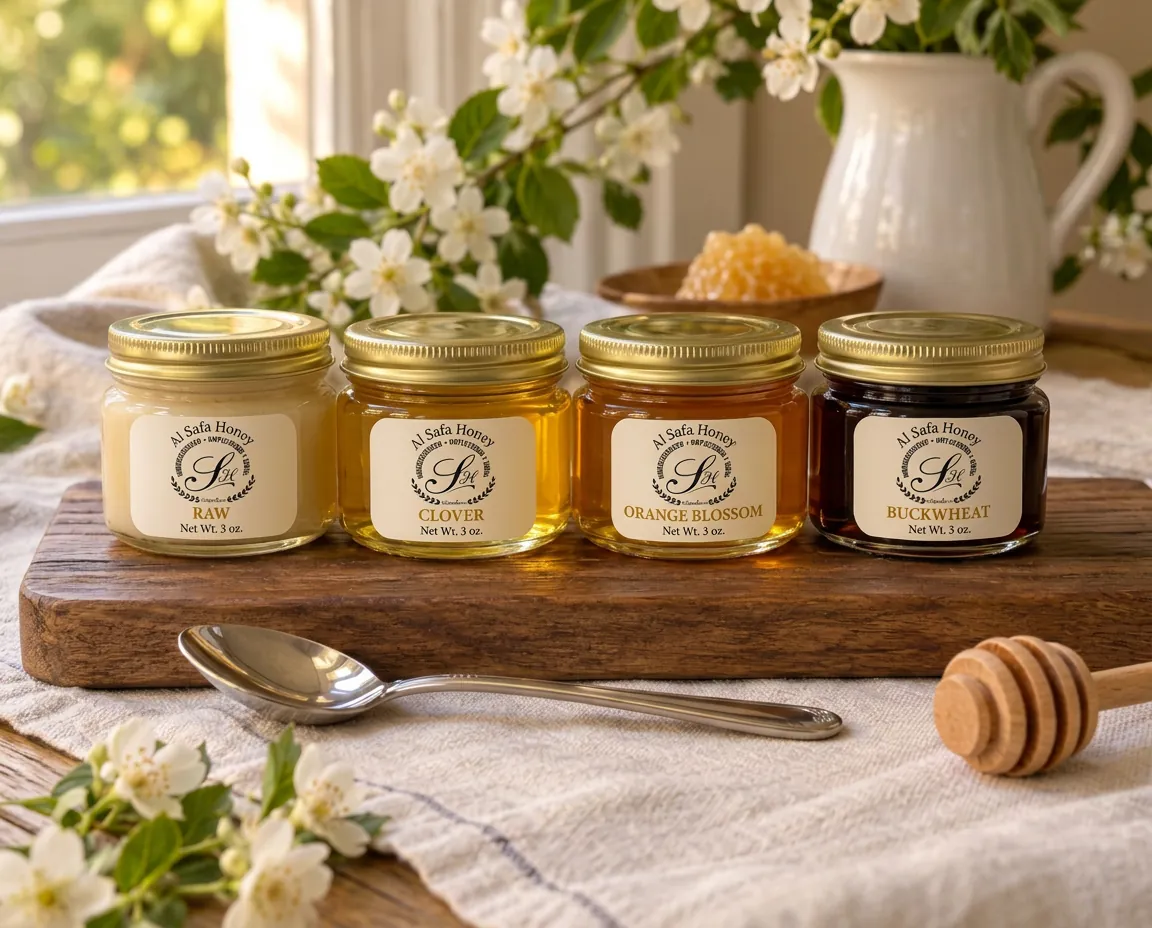
For Eid gifts, a selection of single-origin honeys lets the recipient taste how different one bloom is from another. A sampler of small jars or a pair of contrasting full jars, one light and one dark, makes a thoughtful present. As always, keep honey away from babies under 12 months, whatever the occasion.
Frequently asked questions
- Is raw honey halal?
- Raw honey is simply honey that has not been heated or finely filtered, so the same reasoning applies: scholars widely consider pure honey halal. Raw honey contains traces of pollen and wax, which are not considered a problem.
- Does honey contain alcohol?
- Fresh, properly stored honey does not contain meaningful alcohol. If honey with a high water content ferments, it can develop a sour, boozy smell, and that honey should be discarded. Mead, a fermented honey drink, is alcoholic and is not halal.
- Is honey with bee parts in it halal?
- Commercial raw honey is strained to remove wax and debris, so you should not find bee parts in a jar. Scholars generally view tiny traces that cannot be separated as forgiven, but ask a trusted scholar if this concerns you.
- Do I need halal-certified honey?
- Many Muslims buy pure honey without certification because it has only one ingredient. Others prefer certification for all packaged food. Either is a valid personal choice, and your local scholar can advise.
- Is manuka honey halal?
- Pure manuka honey is treated like any other pure honey. As with any product, check that it has no added flavorings or ingredients of doubtful origin.
Al Safa Honey is a food producer, not a medical provider. Nothing here is medical advice. Never give honey of any kind to a baby under 12 months old.