Wild Honey: Honey Hunting, Wild Bees and What the Label Really Means
Wild honey is honey taken from colonies that live on their own, in hollow trees, rock crevices and cliffs, rather than in a beekeeper's hive. For most of human history, all honey was wild honey, and in parts of Africa and Asia people still hunt for it today. On store shelves, though, the phrase has a looser meaning. This guide covers both: the real wild honey of honey hunters, and what a wild honey label usually tells you.
Honey before beekeeping
Long before people kept bees, they robbed wild nests. A rock painting in the Cuevas de la Araña in eastern Spain, thought to be around 8,000 years old, shows a figure climbing ropes or vines to a bees' nest, surrounded by bees. Similar honey-gathering scenes appear in rock art in southern Africa and India. Honey was one of the few concentrated sweet foods available to early humans, and it was worth the stings.
The Bible also remembers wild honey: John the Baptist is described as living on locusts and wild honey in the desert. See our journal piece on honey in the Bible.
Honey hunters today
Wild honey hunting continues in many places. In the foothills of the Himalayas in Nepal, honey hunters climb rope ladders down cliffs to cut combs from the giant Himalayan cliff bee, Apis laboriosa, a practice that has become famous through documentaries. In the forests of Southeast Asia, honey hunters climb tall trees at night to harvest the nests of the giant honey bee, Apis dorsata. In Tanzania, Hadza hunter-gatherers still get a large share of their calories from wild honey in some seasons.
The bird that leads people to honey
In parts of Africa, people and a wild bird work together to find honey. The greater honeyguide leads honey hunters to bees' nests, and once people open the nest, the bird eats the leftover wax and larvae. A 2016 study in the journal Science showed that honeyguides in Mozambique respond to a special call that Yao honey hunters use, and that answering the call greatly raises the hunters' chances of finding a nest. It is one of the clearest examples of cooperation between humans and a wild animal.
What wild honey means on a label
In the US, wild honey is not a defined or regulated term. On store shelves it usually describes honey from bees that forage on uncultivated land, such as forests, mountains or wild meadows, rather than on crop fields. Most of it still comes from managed hives, because that is how honey is produced at any scale. Some imported products are labeled wild forest honey, which may be honeydew or blossom honey from forested regions.
None of that makes wild honey better or worse in itself. The useful questions are the same as for any honey: where it comes from, what the bees foraged on, and whether it was heated or finely filtered. Our guide on how to tell if honey is real covers what labels can and cannot tell you.
| Term | What it usually means |
|---|---|
| Wild honey (strict sense) | Taken from wild colonies by honey hunters |
| Wild honey (store label) | Bees foraged on uncultivated land; often managed hives |
| Wildflower honey | Nectar from many mixed flowers |
| Wild forest honey | Forest blossoms or honeydew, depending on the source |
Wild honey vs wildflower honey
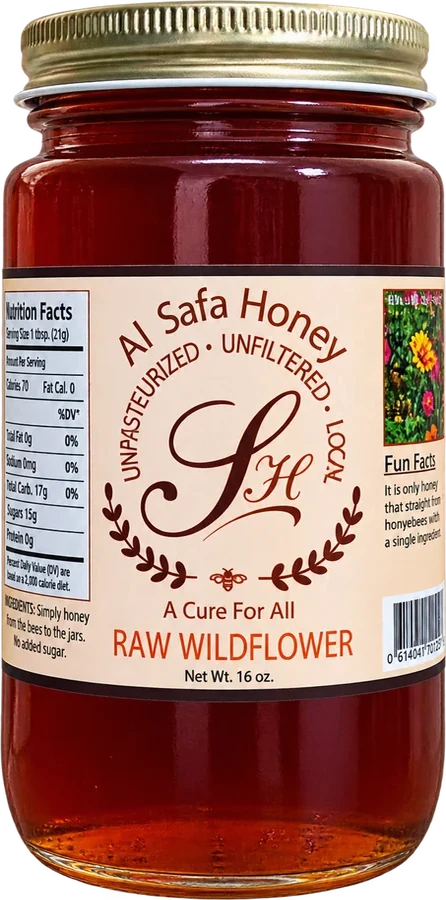
These two get mixed up often. Wildflower honey describes the nectar: many different flowers rather than one crop. Wild honey describes the bees or the land: wild colonies or wild forage. A wildflower honey can come from a beekeeper's hive in a meadow. Our wildflower honey guide explains how its flavor changes through the season.
Our own Wildflower honey comes from managed hives kept by partner beekeepers in New York State, foraging on meadow and woodland blooms, and is never heated above hive temperature.
Is wild honey safe?
Honey from wild colonies is generally similar to other honey, but it is not inspected or handled like commercial honey, and it can contain wax, bee parts and debris. In a few places, honey from certain plants can be harmful: honey made from some rhododendron species in the Black Sea region and the Himalayas contains grayanotoxins and is known as mad honey. See mad honey. And as with all honey, never give it to a baby under 12 months.
Sources
Frequently asked questions
- What is wild honey?
- In the strict sense, honey gathered from wild bee colonies. On store labels it usually means bees foraged on uncultivated land.
- Is wild honey the same as wildflower honey?
- No. Wildflower honey describes mixed flower nectar. Wild honey describes wild colonies or wild land.
- Is wild honey a regulated term?
- Not in the US. Check the label for the origin and the producer's description of where the bees foraged.
- Do people still hunt wild honey?
- Yes, in parts of Africa, Nepal, India and Southeast Asia, often by climbing trees or cliffs.
Al Safa Honey is a food producer, not a medical provider. Nothing here is medical advice. Never give honey of any kind to a baby under 12 months old.